2026-05-23
2. What Should We Consider? (a.k.a. Evaluation Criteria)
A board-certified plastic surgeon walks through the six key factors evaluated before double eyelid surgery: ptosis, skin thickness, fat, skin sagging, revision history, and technique preference.
Hello.
I'm Dr. Yoo Young-moon, a board-certified plastic surgeon.
When I first meet a patient coming in for a consultation,
what do plastic surgeons — and I in particular —
look for first?
And what goes through my mind?
- Presence or absence of ptosis
- Skin thickness
- Degree of fat (fullness)
- Skin sagging
- Whether it is a revision surgery
- Preferred surgical technique (or techniques to avoid)
1. Presence or Absence of Ptosis
Why does the presence of ptosis matter?
Why are double eyelid surgery and ptosis correction so inseparable?
To understand this, you first need to grasp
the fundamental principle behind double eyelid surgery.
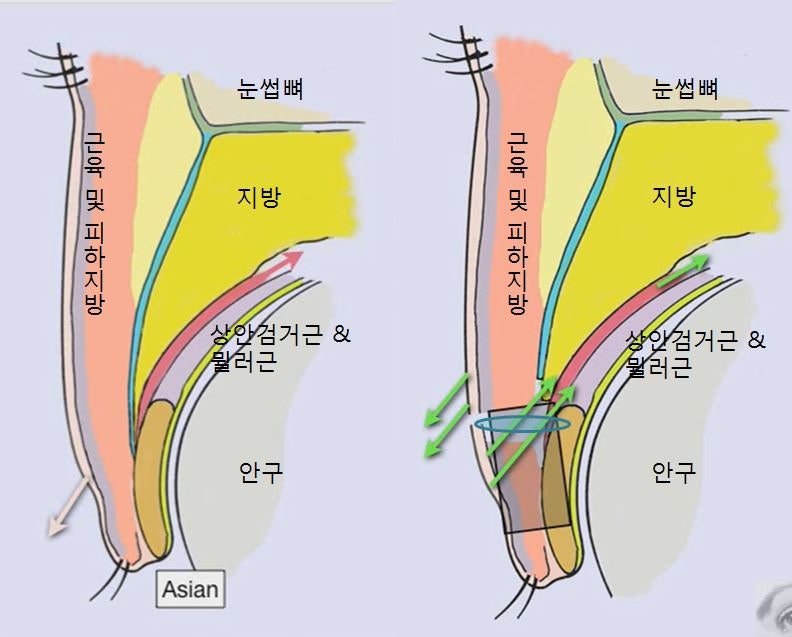
Double eyelid surgery is a procedure that 'connects the skin to the eyelid-opening structures using sutures.' When you open your eyes, the connected skin gets pulled upward and creases — that crease is the double eyelid.
Conversely, when your eyes are closed, the double eyelid fold should not be visible.
(A fold that looks deep even with eyes closed is... scar tissue.)
Therefore, strong eyelid-opening muscle strength leads to
a crisp, well-defined double eyelid fold
without multiple overlapping creases.
That's why the presence or absence of ptosis matters so much.
If ptosis is present —
meaning the eyelid-opening muscle is weak —
the fold won't form crisply,
and it will eventually loosen and come undone.
2 & 3. Skin Thickness & Degree of Fat
As illustrated above, when connecting the skin to the inner structures,
if there is too much intervening tissue, the fold is far more likely to loosen.
That's why patients with thick skin or excess fat
need to have some of that skin or fat removed while creating the fold —
so it won't come loose easily,
won't look puffy or sausage-like,
and so the adhesion sets properly.
4. Skin Sagging
Significant skin sagging covers the fold,
making the desired crease height invisible.
Mild sagging may be compensated by raising the design height,
but as a general rule, sagging of 3–4 mm or more
is best addressed through incision blepharoplasty, a sub-brow lift, or an endoscopic forehead lift.
5. Revision Surgery History
It is essential to know exactly what procedures were performed previously — specifically,
whether it was non-incision (buried suture) or incision blepharoplasty,
non-incision or incision ptosis correction,
and which epicanthoplasty technique was used and how...
Only by having a clear picture of this surgical history can we
plan thoroughly before the operation
and anticipate and manage any variables that may arise during surgery.
6. Preferred (or Strongly Undesired) Surgical Technique
For example, some patients can achieve their desired fold perfectly well with the non-incision (buried suture) method alone.
But what if the patient wants an incision?
(Patients who have seen others' sutures come undone often arrive with exactly this concern.)
'Your eyelid skin is thin enough and your eyelid-opening strength is good, so the non-incision method alone is perfectly sufficient. However, if you are genuinely worried about it loosening and would prefer the incision method, that is entirely your decision.'
I explain it this way and let the patient decide for themselves.
There are very few situations in life where only one right answer exists.
This is a case where the choice is entirely yours.
That said, there are cases where incision-based ptosis correction is absolutely necessary:
weak eyelid-opening strength, thick skin, excess fat, mild sagging... and so on.
In those cases, incision ptosis correction is an unconditional recommendation.
But what if the patient had only considered non-incision and came in with that in mind?
What if they want to avoid an incision because they're worried about scarring?
Then the consultation gets a lot longer. ^^;;
Why non-incision alone isn't sufficient, what problems arise if only non-incision is done...
Why incision-based ptosis correction is necessary...
Why having an incision doesn't mean worse scarring...
Why an incision doesn't mean a longer recovery...
And so on.
Only after a thorough explanation — and once the patient truly understands —
does the fear and anxiety around surgery ease,
and satisfaction with the outcome improve.
Today we covered
'What should we consider when planning eyelid surgery?' (a.k.a. Evaluation Criteria).
For some of you, much of this will already be familiar,
and for others, I hope there was plenty here that proved useful.
After a long time trying to convey so much through writing rather than photos,
I find myself wondering whether I got my points across clearly,
and whether there are any phrases that might be misread.
The archive will continue with diverse content on an ongoing basis.
(I'm sorry in advance for the irregular, sporadic posting schedule.)
See you next time!
Right thinking, right plastic surgery — Dr. Yoo Young-moon