2026-05-18
Buried Suture Revision: Should You Switch to Incision? A Guide to Making the Right Choice
If your double eyelid line from a buried suture procedure has loosened or you're unhappy with the result, this guide helps you decide between another buried suture revision or switching to incision. The appropriate revision method varies based on eyelid thickness, fat volume, and scarring. If buried suture has been repeated multiple times, incision may be necessary. Ultimately, having a specialist directly examine your eye condition is the safest way to make the right decision.

Many patients who had double eyelid surgery with the buried suture method find their line loosening over time or feel unhappy with the result.
"Can I just redo it with buried suture again?"
"Or should I switch to incision this time?"
The answer to this dilemma is actually simpler than you might think.
✔️ When Buried Suture Revision Is Possible
The buried suture method fixes the eyelid line with thread, without cutting the skin.
Recovery is fast and scarring is minimal, which is why it's a popular choice for first-time double eyelid surgery.
However, if the eyelid has a lot of fat or thick skin, the chance of the line loosening over time increases.
You may be a candidate for a buried suture revision if any of the following applies:
✅ The double eyelid line has loosened or faded
✅ You want to slightly adjust the height or shape of the line
✅ Your eyelids are thin with little fat
✅ There is no significant scarring or adhesion
✔️ When You Should Switch to Incision
The incision method directly cuts the skin to fix the line in place,
so it offers much stronger durability and allows fat and excess skin to be addressed at the same time.
Many cases that buried suture cannot resolve can be fundamentally corrected with incision.
Consider incision revision if any of the following applies:
👉 You've had buried suture repeated multiple times or have scar tissue
👉 Your eyelids are thick or have a lot of fat
👉 You have significant asymmetry or an irregular line
👉 You want long-lasting, reliable results
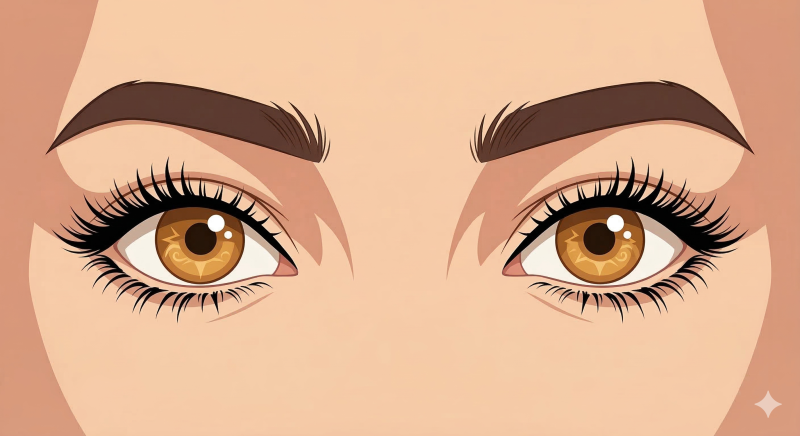
✔️ Why Is Revision Surgery More Challenging?
Unlike the first surgery, revision means working on tissue that has already been operated on.
When scarring or adhesion is present, the difficulty rises and predicting the outcome becomes more complex.
In particular, if buried suture has been repeated 2-3 times or more,
scar tissue builds up internally, making any future incision revision significantly more difficult.
That's why, rather than thinking "let me just try buried suture one more time,"
it's important to have a proper assessment of the method best suited to your current eye condition.
✔️ What Matters Most Is an In-Person Examination
Even with the same symptoms,
the right method can vary completely depending on
eyelid thickness, skin elasticity, and any existing scarring.
Some people are good candidates for a buried suture revision,
while others need to switch to incision this time.
Rather than deciding based on internet information alone,
having a specialist examine you in person is the most accurate and safe approach.
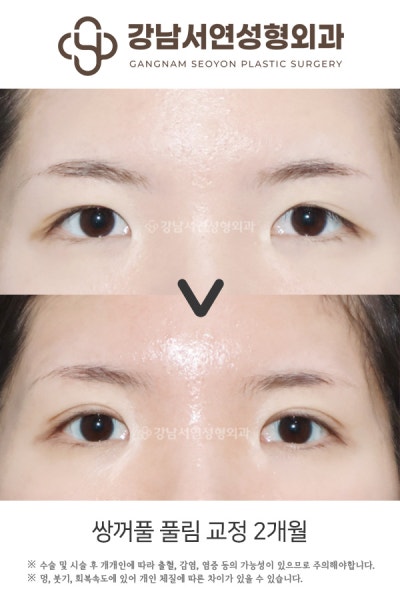
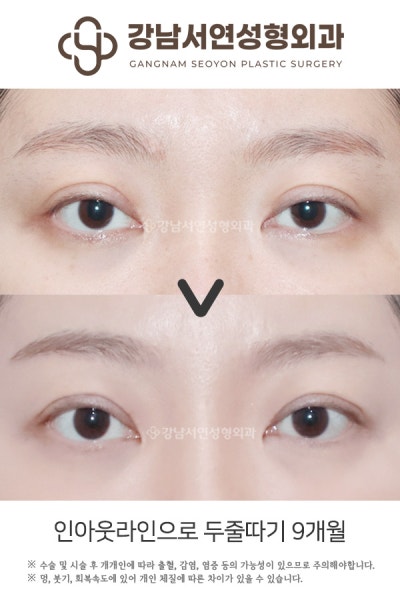
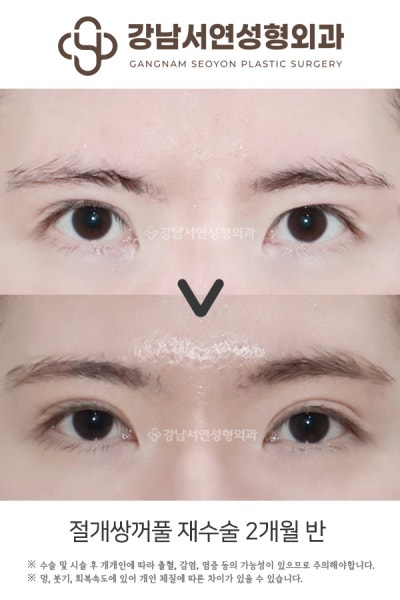
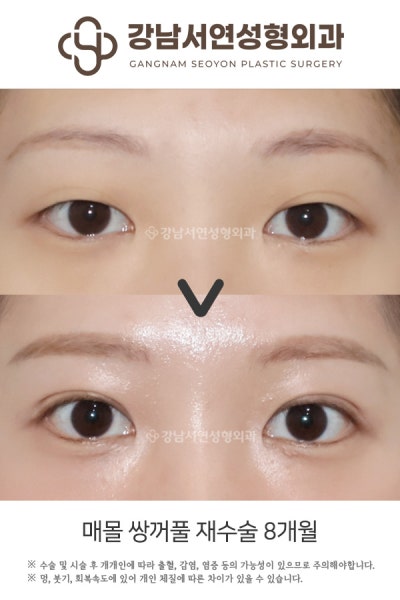
Gangnam Seoyeon Plastic Surgery Clinic complies with medical law. The photos in this post were taken under identical conditions and with the patient's prior consent. Additionally, side effects such as bleeding, infection, and inflammation may occur after plastic surgery and procedures depending on the individual, so caution is required.
|
- Single board-certified plastic surgeon chief director system - Accurate assessment of your eye condition /recommending only necessary surgery - Operating room equipped with CCTV |
Feel free to visit and receive a one-on-one consultation
with our board-certified plastic surgeon :)
If you have any questions or would like a consultation,
please leave a comment, message us on KakaoTalk Plus Friend @Gangnam Seoyeon Plastic Surgery Clinic,
or call us at 02-535-8889 :)





Frequently Asked Questions
When is a buried suture revision possible?
Buried suture revision may be possible if your double eyelid line has loosened or faded, if you want to slightly adjust the height or shape of the line, if your eyelids are thin with little fat, or if there is no significant scarring or adhesion.
When should you switch to the incision method?
Incision revision may be considered if you've had buried suture repeated multiple times or have scar tissue, if your eyelids are thick or have a lot of fat, if you have significant asymmetry or an irregular line, or if you want long-lasting results.
Why is revision surgery more difficult than the first procedure?
Revision involves working on tissue that has already been operated on, so it's performed in the presence of scarring or adhesion, which increases the difficulty and makes outcomes harder to predict. In particular, repeating buried suture 2-3 times or more leads to scar tissue buildup, making revision even more challenging.
Why can the buried suture method loosen over time?
The buried suture method fixes the line with thread without cutting the skin, offering fast recovery and minimal scarring. However, if the eyelid has a lot of fat or thick skin, the fixed line is more likely to loosen over time.
What are the advantages of incision revision?
The incision method directly cuts the skin to fix the line in place, providing much stronger durability and allowing fat and excess skin to be addressed at the same time. This means that even cases that cannot be resolved with buried suture can often be fundamentally corrected.
How should the revision method be decided?
Even with the same symptoms, the right method can vary completely depending on eyelid thickness, skin elasticity, and any existing scarring. Rather than deciding based on internet information alone, having a specialist examine your eye condition in person is the most accurate and safe approach.